Ripingo Waste ManagementMember access

Break Into Waste Hauling in 6 Steps

  1. 1. Get your USDOT (and MC only if you'll haul interstate)

    Confirm your operation with FMCSA and your state. Interstate commerce can include local legs; exemptions and state requirements matter. A USDOT number alone is not operating authority.

    Register through Motus, FMCSA's registration system (motus.dot.gov).

    FMCSA registration guide →
  2. 2. Get commercial auto and cargo insurance

    Ask a licensed agent to match coverage to your material, equipment and customer requirements. Obtain written limits and exclusions before agreeing to a haul.

    Free insurance preparation lesson →
  3. 3. Pick your equipment

    Compare walking floor / tipper, end dump, roll-off and scrap gondola / lugger against loading, unloading, payload and site restrictions.

    Free equipment foundations lesson →
  4. 4. Find transfer stations and landfills near you

    Choose your state, identify nearby receiving sites and confirm commercial acceptance before planning a route.

    Open the nationwide directory →
  5. 5. Call scalehouses and get approved

    Verify fees, hours, material, account ownership and onboarding documents. Ask for written confirmation.

    Free scalehouse call scripts →
  6. 6. Land your first dedicated or overflow contract

    Present your own carrier information and equipment, agree written scope and payment terms, and verify complete turn costs before committing.

    Free proposal and forms preview →

Free Starter Checklist

Enter your email for the six-step PDF. Your request is saved for support; no PIN or payment required.

We use your email to respond to this request. Privacy policy

Preview Free Tools & 27 Forms
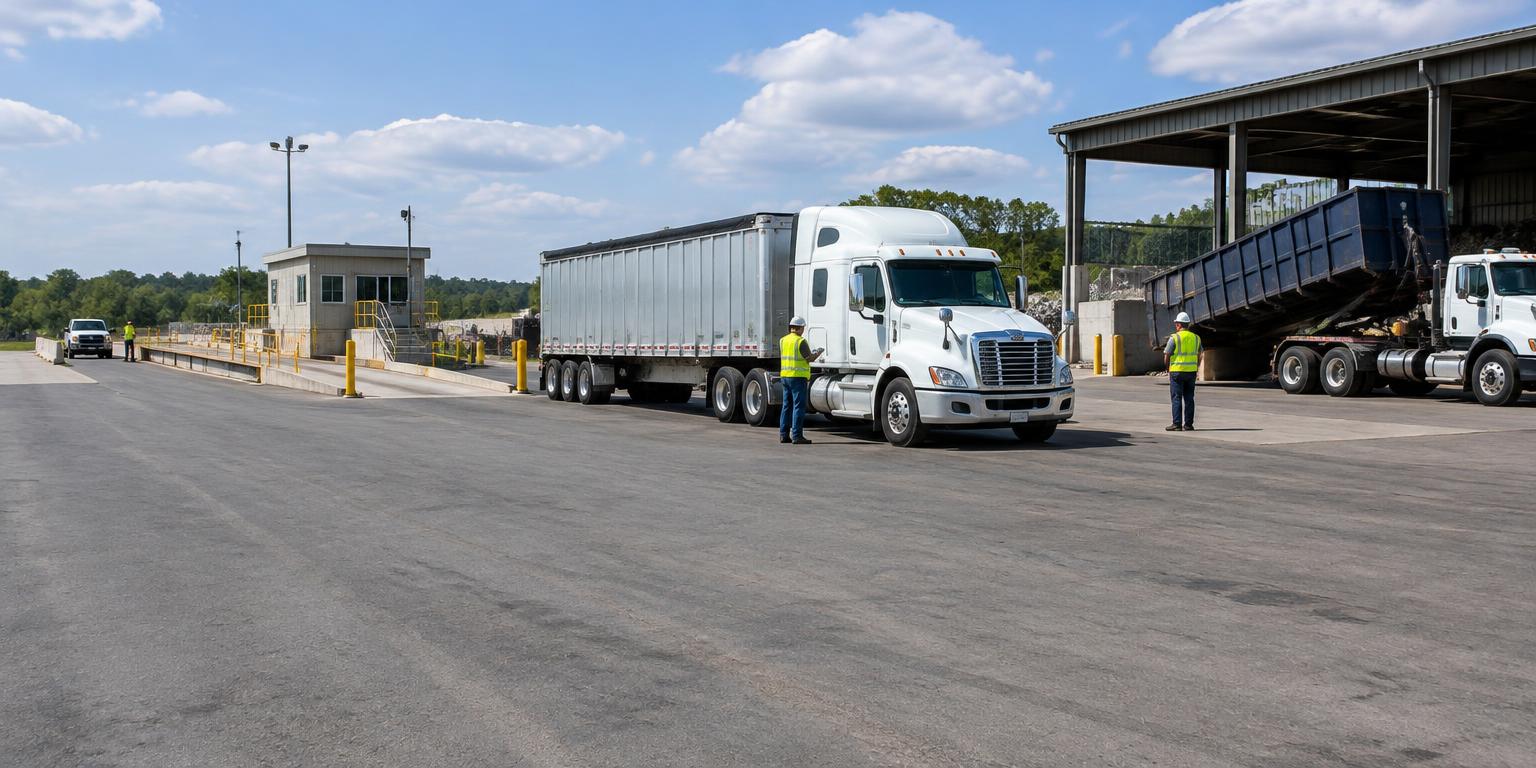
Walking-floor tractor trailer beside a transfer station weighbridge

Ripingo Waste Management COMMAND ACADEMY

The Ripingo Waste Management Master Curriculum for Class 8 Waste, Dump & Scrap Operators

Four educational modules for your independent business: Class 8 waste and scrap hauling, scalehouse and transfer-lane cost planning, independent brokerage and dispatch workflows, and fleet finance and growth planning. Module 1 is free for everyone.

TRACK 1 · CORE CLASS 8 WASTE, DUMP & SCRAP CURRICULUM

MODULE 1 · BEGIN WITH THE FREE OPERATING FUNDAMENTALS

Ripingo Waste Management Foundations: Recurring Loads, Real Costs

Explore recurring waste and scrap movements, separate customer onboarding policies from legal requirements, and compare short-haul opportunities using complete cycles and estimated net earnings.

LESSON 1 · 8 MIN

Build Around Recurring Material Movement

Follow the material stream

A softer freight market does not empty a transfer pit or stop a fabrication shop from filling its scrap bins. Municipal solid waste (MSW), construction and demolition (C&D) debris and recyclable metal still need outlets. Ripingo Waste Management starts with that recurring need: identify the facility accumulating material, its receiving destination and the Class 8 capacity required to connect them. Volume and rates can still decline; recurring waste is not a revenue guarantee.

Become part of the operating schedule

A transfer manager needs outbound trailers available before the floor backs up. A scrap processor needs finished loads removed before the next inbound batch arrives. Instead of chasing unrelated spot postings, look for a repeat transfer-to-landfill, demolition-debris or scrap-to-mill assignment where predictable service solves a measurable operating problem.

Let the load determine the equipment

Match the entire loading and unloading process, not merely the commodity name. Transfer MSW may suit a walking-floor trailer or a trailer approved for the receiving site’s tipper. Suitable C&D can move in an end dump; container exchanges call for roll-off equipment; scrap may require a gondola or lugger arrangement. Verify payload, securement, site clearance and any hydraulic wet-kit requirements before offering a truck.

Ripingo Waste Management takeaway: Find a recurring material bottleneck, then offer equipment and service that actually remove it.

LESSON 2 · 6 MIN

Compete Beyond the Authority-Age Filter

Separate onboarding policy from regulation

A broker may decline an MC authority that has not reached 90 days, six months or a year. Those thresholds are commercial screening decisions, not a universal federal waiting period. A new carrier should distinguish a customer’s onboarding preference from the registrations legally required for the proposed operation.

Present a lane-specific qualification package

For a demolition contractor seeking an end dump, equipment suitability and dependable arrival times may matter more than a generic freight profile. Ripingo Waste Management does not set an authority-age threshold, but that does not override a customer’s rules. Ask each hauler, yard or transfer operator about insurance, safety standards, authority age and payment setup before treating the opportunity as approved.

Check the movement, not just the mileage

A nearby landfill trip may be intrastate, but distance alone does not establish regulatory status. Interstate for-hire property operations generally need a USDOT number and applicable operating authority; state and municipal waste requirements may also apply. Review the actual service with FMCSA and the relevant state agency. Educational, not licensing advice: this lesson does not authorize any haul.

Ripingo Waste Management takeaway: Replace assumptions with a documented check of the customer’s standards and the lane’s legal requirements.

LESSON 3 · 9 MIN

Make the Complete Turn Count

Treat load rates as inputs

For Ripingo Waste Management planning, local scrap work may be modeled around $175–$225+ per load and transfer-to-landfill service around $300–$375+ per load. These figures are illustrative ranges rather than offers. A short scrap run with slow crane loading can perform very differently from a transfer route with staged trailers; validate distance, payload, queues and written terms locally.

Measure the truck’s full cycle

Divide available working hours by the combined loading, driving, scale/tip waiting and return time to estimate daily turns. For example, a transfer operator that stages outbound trailers might remove 20 minutes from each cycle and make another legal turn possible. Record actual timestamps during the first week; do not price a full shift from the best trip alone.

Compare revenue without confusing it with earnings

Consider a Class 8 tractor assigned four landfill deliveries at $340: gross receipts total $1,360. A separate scrap shuttle completing five deliveries at $200 grosses $1,000. Neither figure pays the owner until operating expenses are covered. Use the True Net Profit calculator to compare the routes on costs and time, not their headline checks.

Ripingo Waste Management takeaway: Choose the repeatable schedule that produces worthwhile net earnings within safe, legal working limits.

LESSON 4 · 10 MIN

Price the Work After Counting the Costs

Charge each trip for the resources it uses

A landfill delivery consumes more than diesel on the loaded leg. Count empty-return fuel, engine idling in the queue and a mileage-based reserve for tires, brakes, PTO and hydraulic repairs. Allocate truck and trailer finance, insurance, permits and phone/ELD expenses across the workday rather than pretending those bills disappear between loads.

Separate operating remainder from personal pay

Subtract road fuel, waiting-time fuel, maintenance reserves and daily fixed expenses from gross revenue to estimate the daily operating remainder. Hired-driver wages and related payroll expenses must also come out. An owner driving the truck should compare that remainder with reasonable compensation for the hours worked before calling the lane attractive.

Replace defaults with lane evidence

Use your quoted load rate, achievable turns, round-trip distance, MPG, diesel cost, scale delay, repair reserve and daily overhead in the calculator. Read its per-load costs alongside its daily and weekly net estimates. The tool is a planning aid, not a complete accounting system; separately allow for expenses it does not model and verify assumptions against actual tickets and bills.

Ripingo Waste Management takeaway: Set an acceptance price from the lane’s full cost picture, not from the size of its gross settlement.

MODULE 1 · FREE LESSON

Scalehouse Rate-Verification Call Scripts

Opening

“Hello, my name is [Name] with [Your Company Legal Name]. I’m researching commercial [material] deliveries using [equipment]. Is this the right desk to confirm receiving requirements and account setup?”

Fees and weighing

“What is the current tipping fee for this exact material, and is it charged per ton, per load or with a minimum? Are taxes, environmental charges, fuel charges or special-handling fees extra? What tare procedure and weight tickets do you require? Could you email the written schedule and its effective date?”

Hours and accepted materials

“What are the receiving hours and last-truck cutoff? Do weekends or holidays differ? Is this material accepted from outside commercial haulers? What items are prohibited? Is a profile, testing, tarp or appointment required? What happens if a load is rejected?”

Account approval

“Who must hold the disposal account: the generator, contractor or carrier? What credit application, insurance, W-9 and vehicle documents do you need? Can a new carrier deliver before account approval? Who confirms acceptance and payment terms in writing?”

Close and follow-up email

“Thank you. I’ll send a short summary for your correction; I won’t schedule a delivery until approval is confirmed.”

Subject: Receiving and rate confirmation — [material] / [Your Company Legal Name] Hello [Contact], Thank you for speaking with me. Please confirm: material and equipment [details]; fee and additional charges [details]; receiving hours and cutoff [details]; account holder and approval steps [details]; rejection/tarp/weight rules [details]. Please attach the current rate schedule and identify its effective date. Our requested first delivery is [date], subject to written approval. Please correct any misunderstanding before we commit equipment. [Name] · [Your Company Legal Name] · [Contact]

Insurance preparation

Bring the material, route, equipment and customer’s written requirements to your licensed agent. Ask about commercial auto, cargo exclusions for waste, general liability and required endorsements. A certificate alone does not prove every requested endorsement; confirm actual coverage with the agent. This lesson is not insurance or legal advice.

MODULE 1 · FREE LESSON

Weekly Cost-Per-Ton & Turn Ledger

Record actual ticket tons and completed turns daily. Enter total daily road/idle fuel cost, fixed bills allocated to that day and other costs such as disposal, driver wages and tolls. This ledger reserves 20% of gross for maintenance; do not include that reserve again in Other. Compare cost/ton and cost/turn with written rates. Blank days count as zero; entries stay in this open view.

Day 1
Day 2
Day 3
Day 4
Day 5
Day 6
Day 7

Weekly revenue $0 · 20% maintenance reserve $0 · costs $0 · operating remainder $0 · cost/ton $0 · cost/turn $0

INTERACTIVE · FREE

True Net Profit & Cost-Per-Load Calculator

Cost per load

$87

Net per load

$113

Daily net take-home

$565

Weekly net take-home

$2,827

Daily: gross $1,000 − fuel $138 − idle fuel $6 (2.1 h scale wait) − maintenance $40 − fixed $250. Excludes hired-driver wages and taxes. Planning estimate only, not a quote or guaranteed result.

Set aside 20% for maintenance: $200/day. This alternative gross-revenue reserve is not deducted again from the mileage-reserve result above.

Module 1 Mastery Check

1. What can make a transfer or scrap route less dependent on general spot-freight demand?
2. Where does a customer’s MC authority-age threshold usually come from?
3. Which improvement could let a landfill shuttle complete another safe, legal turn?
4. Which cost bundle belongs in a realistic per-load estimate?
5. How should an operator evaluate a proposed $340 landfill delivery?

Free Class 8 Overflow Lane Alerts & Scalehouse Recon Cheat Sheet

Tell us your state and equipment. Your cheat sheet and matching facilities unlock instantly on this screen. No PIN or payment needed.

Ready for the execution playbooks?

CERTIFICATE OF COMPLETION

Your progress: 0 / 16 lessons · quiz 0 / 5

Your Module 1 progress is saved on this device. The certificate requires all 4 modules, which need a subscriber PIN.

TRACK 2 · VIP BONUS

VIP Bonus: Hauler-to-Licensed Freight Broker Authority Masterclass

Included with Dispatcher $69.97, Pro Training & Tools $99.97 & Enterprise $299.97

Educational course. Ripingo does not issue broker authority; you apply with FMCSA yourself.

BONUS INCLUDED: Hauler-to-Broker Authority Masterclass + 27 White-Label Contracts · Dispatcher $69.97 · Pro Training & Tools $99.97 · Enterprise $299.97

Included free with Dispatcher ($69.97/mo) or higher

  • Module 1 · From Cab or Dispatch Desk to FMCSA Property Broker Authority
  • Module 2 · Brokerage Entity, Contingent Cargo & GL Coverage, and Authority Separation
  • Module 3 · Sourcing Municipal, Transfer, C&D and Scrap Overflow Shippers
  • Module 4 · Sub-Hauler Qualification, Safety Screening & Double-Brokering Prevention
  • Module 5 · Per-Ton vs. Per-Turn Margin Engineering, Ticket Audits & Part 371 Records
Upgrade to Dispatcher to unlock

Not sold separately. After payment, your PIN is activated by Command; payment links alone do not unlock access.

Educational material, not legal, tax or insurance advice. Confirm current filing requirements with FMCSA and your licensed agent.

Ripingo Waste Management Command Academy content is proprietary educational material. It is not legal, tax, insurance or financial advice, and the certificate of completion records course completion only — it does not confer any license or government certification. Revenue figures are illustrative planning examples, not guaranteed results.

PLATFORM OPERATIONS & SUPPORT

Platform Support1-804-534-5414 · callMember Supportsupport@ripingowaste.com

Response timeSame business day for emails and voicemails received Mon–Fri, 8 AM–5 PM ET; next business day otherwise.

Directory revisionFacility directory & fee index revised October 26, 2026